11. Pneumatic pilot valve
Pneumatic piloting consists of moving a valve into position thanks to the force of pressurized air.
Below you can see the symbol of a pneumatically piloted valve:
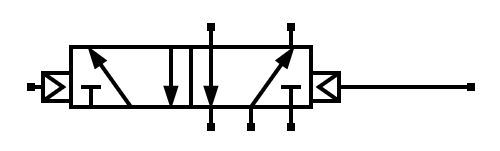
Symbol of the 5/2 valve with double pneumatic pilot.
Pneumatic piloting has two great advantages:
Allows large valves to be easily moved.
A 5/2 valve for a large cylinder must also be large and therefore difficult to move manually. Thanks to pneumatic piloting, a small, easy-to-use valve can move large valves with little effort.
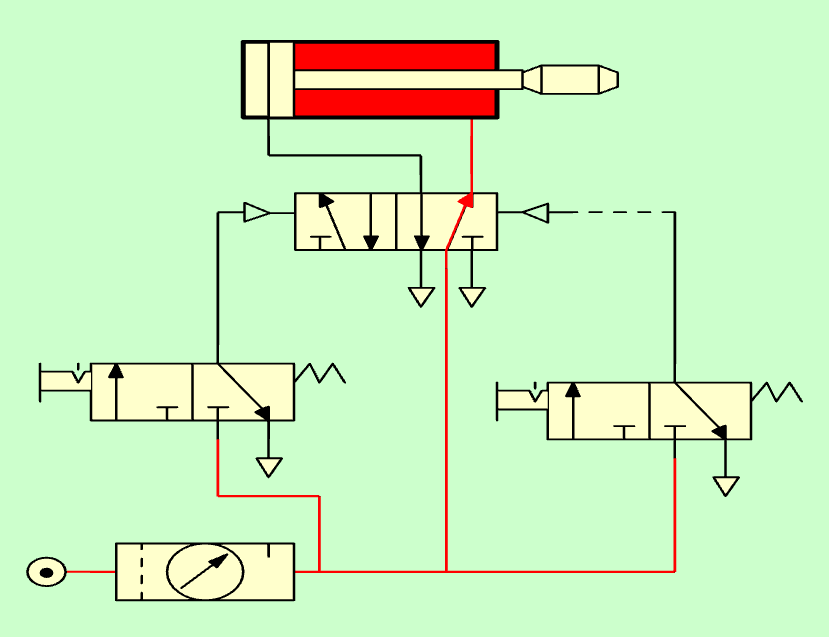
Large and heavy 5/2 valve with double pneumatic pilot operated by small 3/2 manual valves.
Allows you to automate movements.
Thanks to pneumatic piloting, the pneumatic installation itself can activate the cylinder valve to produce automatic movements. For example, a pneumatic roller limit valve can cause a cylinder rod to re-enter once it has detected that it has fully exited.
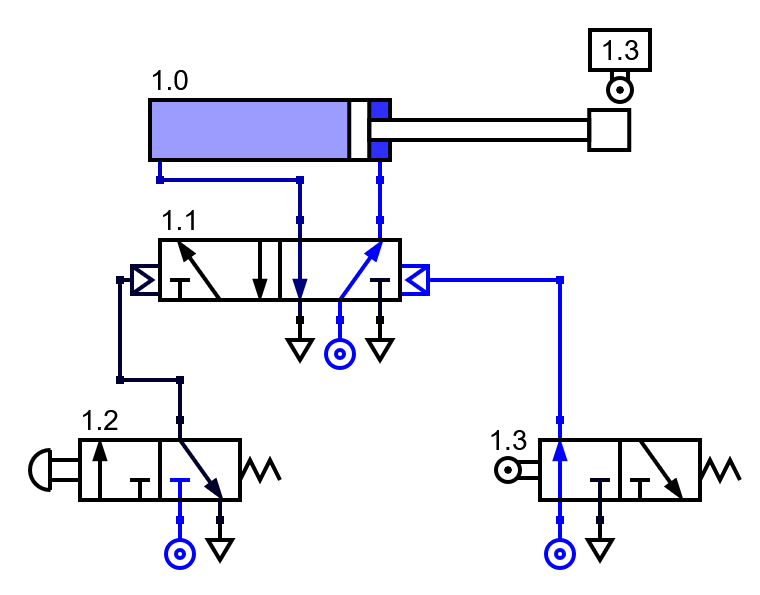
5/2 valve with automatic pneumatic pilot.
Exercises
Draw the symbol of a 5/2 valve with double pneumatic pilot.
What are the advantages of pneumatic valve piloting?
Draw the diagram of a double-acting cylinder, actuated by a 5/2 double pneumatic pilot valve, which in turn is piloted by two 3/2 manual valves.
Simulates the operation of the previous circuit.
Explain the operation of the above circuit and its advantages.
Draw the diagram of a double-acting cylinder, actuated by a 5/2 double pneumatic pilot valve, which in turn is piloted by a 3/2 manual valve so that the cylinder exits and by a roller valve (limit stroke) so that the cylinder enters.
Simulates the operation of the previous circuit.
Explain the operation of the above circuit and its advantages.